by Miles Harrop | Jul 18, 2026 | Uncategorized
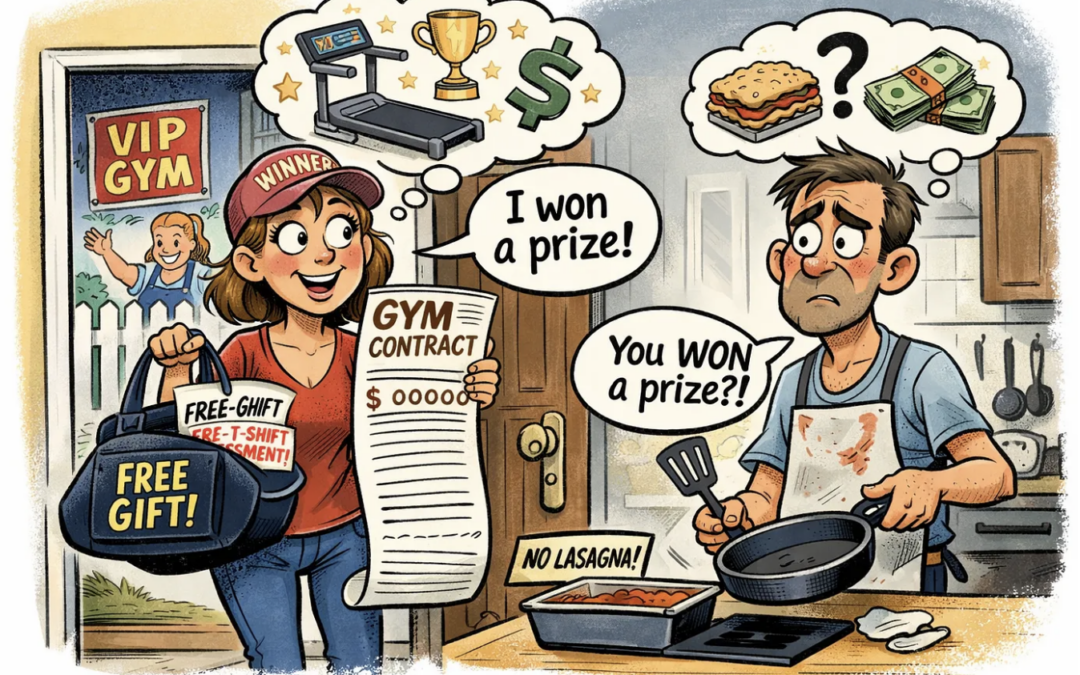
A man with a frying pan is trying to negotiate a complicated Italian pasta dish.
He badly misses the help he used to get with his culinary “creations.”
That former helper is now sitting at the kitchen table, arms folded, glaring at him.
She would love to phone a friend.
She has been banned from using her phone.
The man will be making his own supper tonight.
The man’s name is Mr Jones. First names are not important. Not when you’re sweating over a lasagne that is clearly missing something vital.
Whither those missing ingredients?
This is the story of the missing lasagne ingredients.
The Last Deal: Dark Influence and the Mrs Jones Inside Your Head
Poor old Mrs Jones stands with a dazed expression on her face.
That blank, uncomprehending look you’d expect on the blood-spattered survivor of a plane crash. I’ve never actually seen one, which is a tad unsettling, given the level of confidence I showed by lobbing that in.
“Thank you,” says Mrs Jones politely, and walks straight into the glass sliding door.
A door which is still currently completing the rat trap into which she has stumbled.
Her nose smears against the glass like a fleshy bug. She is wondering distantly about the phone call that got her in here. Something about some prize. It made so much sense at the time.
She cannot remember whether she has been given a prize at all. Poor old Mrs Jones has no real sensory acuity or memories about anything right now.
Mrs Jones, like 92% of gym members, will never return to the gym.
Her main concern is what has happened to her nose?
Why is the door closed?
“ a ggumabagggha” she says as her septum deviates into a crumple zone.
“Excuse me” Derek the salesperson says “Is say is that with two O’s before the “bagggha”?. He is still trying to finish up the “agreement” which details, amongst other things, how much Mr Jones has actually paid for her “prize”.
He had not seen the continued commotion at the door involving the now snotty face of Mrs Jones leaving a mess on the door.
“Oh dear!” Derek says, You’re trying to egress before taking your copy of the contract that you may or may not believe that you have just signed. “We can’t have that Mrs Jones, now can we? Tut Tut!”
And we certainly couldn’t.
Derek hands the contract to Mrs Jones (although nobody has asked why she needs a contact when she just came to pick up a free gift. Wonders never cease).
He unclips the child-proof lock holding the door closed from the safety of his desk.
Mrs Jones, like 92% of gym members, will never return to the gym.
Gym Fever and the Art of the Hux
The fitness industry did not arrive with a whimper.
It arrived with a Bang. It kicked the door in. Shot the lights out.
Especially for poor old Mrs Jones.
Almost overnight, the money model flipped from quiet, month-to-month dumbbell-slinging bodybuilders to lifetime memberships that looked suspiciously like golf club contracts:
exclusive status, restricted usage, and “founder” memberships that sounded historic but mostly funded someone’s new car.
The money lenders had arrived.
Gyms now had glass offices and credit card machines.
Gyms were making money.
Gym sales reps were driving Porsches and talking about “targets” instead of triceps.
Why, you may patiently scream, would a gym need a salesperson to sell something people already walk in and ask for?
Good question.
This is not fitness.
This is the Art of the Hux.
What they want is a simple month-to-month membership at a fair price.
What the gym is offering is a lifetime membership, thoughtfully calibrated to whatever obscene amount your extended credit card facility can tolerate without bursting into flames.
It is the early 1990s, and Derek is one of those salespeople, working for a national gym group in South Africa.
This is not fitness.
This is the Art of the Hux.
Do You Feel Sorry for Mrs Jones?
Mrs Jones is unaware of the techniques that have been used on her. Its not the first time they have been used on her. Mrs Jones, like so many of us, has made foolish purchases and decisions before.
She hadn’t been aware of the tricks that have been used on her. But, so what if she had? Would that have made a difference?
Would she have walked away?
Would she have come into this dangerous office in the first place?
You may be surprised at the answers. Perhaps you should not let Mrs Jones off the hook too readily.
“It’s almost too good to be true,” she told her friend Mrs Smith as she left the house.
“I am not stupid, you know. I’m just going to take a look and see what it’s all about. Don’t worry, I won’t buy anything. I am just popping in to get my free gift.”
Indeed you are Mrs Jones! Don't worry, no strings attached.
“It’s almost too good to be true,”
So she does what all good humans do when faced with an exciting offer, free gifts, and a voice in her head screaming “don’t do it”.
She ignores the voice, steps over the red flags, smiles politely at the nice young man with the contract book…
and signs the contract anyway.
In that brief, shimmering moment of insanity, all critical thinking packs its bags and leaves the building.
The salespeople are delighted.
The paid cheerleaders glide in and congratulate her on her wise decision.
She is not particularly happy.
She is not particularly unhappy.
She has, for the moment, almost no recall of what has actually happened.
Poor old Mrs Jones spends the next two hours slowly remembering what, exactly, she has just bought.
The meaning: Just before the close
Just before the close, if we were to sneak a look at the sacred, coffee-stained sales manual “THE HUX: A Complete Sales Guide for Selling Gym Memberships”, we’d probably find something like this:
Reciprocity
- “You’ve won a free gift, Mrs Jones!”
- Start here with the FREE GIFT. People love the word “free” almost as much as they love not going to the gym.
- “Let us give you a free assessment, a free T-shirt, a free body-fat test…”
Keep giving her “free” stuff. The more she accepts, the more she feels obliged to give something back.
- “Giving something back” means signing away 60 months of future cash for the privilege of occasionally using a treadmill that smells faintly of regret.
Scarcity
- Your job is to get her excited about the Founder Membership, then tell he she cant have it.
- When you finally “make a plan” to release one for her, you say “This Founder Membership is only available today, Mrs Jones.”
- If she asks for a Founder Membership too early, you say:
“ooooh, I’m afraid those have all gone. You’ll have to wait ten years until those opportunities come around again.” Add insult to injury by offering her the “Scum” membership which essentially bars her from any of the activities she has shown an interest in.
- If she replies, “But my friend bought one this morning,” you lower your voice and say:
“That’s because someone died.”
- Speak in reverent tones when you talk about the death of a VIP Gym member. When a famous person dies, ensure that you shed a tear and sniff a lot. Say things like “We kept them going another ten years!”
- Scarcity switches off calm evaluation. She stops thinking
“Do I actually want this?”
and starts thinking
“Will I miss out if I don’t grab it right now?”
Social Proof
- Always keep big whiteboards full of names and percentages on display.
Use your premium “Photoshop” skills to make your thinnest clients look like whales in the “before” photos. This is called persuasion.
- When you shake each new member’s hand and congratulate them on their wise decision, keep your voice down. There are five other salespeople doing exactly the same thing in the offices next door. No need to ruin the illusion that they are uniquely special.
- Always wear your “Hundreds of members are transforming their lives!” badge.
In uncertainty, humans look sideways:
“What are other people doing?”
Then they joyfully join the stampede.
Authority
- The Regional Manager “just happens” to be in the club today. What a miracle.
- Invite the Regional Manager into the office to apply more pressure to your weak-willed and argumentative victims. Ensure that the Regional Manager remains standing and towering over the victim.
- Your clients have no idea who the Regional Manager is. As long as the chosen staff member is relatively sober and can form complete sentences, you can introduce them as “our Regional Manager.”
- All discounts must, of course, be personally approved by this benevolent king.
- We are wired to obey perceived authority, especially when we feel out of our depth.
- Your job: keep Mrs Jones out of her depth.
Ideally drowning in jargon and options.
But not actually dead*. That’s bad for debit orders.
- *If the victim begins showing signs of physical stress, get them out of the building as soon as possible. Dead people are really bad for the business of fitness.
Commitment & Consistency
- “Just fill in your details so we can give you your prize,” you say, casually sliding the contract across.
- “Just sign here so we can start your assessment.”
- Once someone says yes to something small, they feel an internal pressure to stay consistent with that yes, even when the stakes escalate from “free T-shirt” to “60-month contract.”
- Special tip:
When your client looks like they want to whinge and whimper about “thinking about it”, look mildly shocked and ask:
- “I did understand you? You did say that staying alive to see your great grandchildren was THE most important thing in your life?”
- Your infallible and inexpugnably effective objection busting questions is “How do you mean?”. Said correctly, this translates to:
“Why would you suddenly become a different kind of person who doesn’t follow through?”
Confusion & Overload
- The contract text is so small it can only be read with a magnifying glass and the eyesight of a young owl. Do not encourage reading. Do not try to read it yourself. None of it actually makes sense.
- If they insist on reading, look at your watch and sigh theatrically. Also keep distracting them with questions about pets, children, sports and their great dress sense.
- You can also say:
“Like all our educated VIP members, you obviously know what’s written here.”
- Keep the pace up with fast talking. If you slow down enough for them to actually process anything, you are finished and will receive a written warning. Three written warnings and you will have to return to being an Estate Agent.
- Ensure there is no quiet space for reflection. No silence. No time to think.
- Cognitive overload makes people more compliant.
When we feel overwhelmed, we outsource our thinking to whoever sounds the most confident.
- In this case: the smiling salesperson with the contract book…
and the Hux manual in their top drawer.
Meet Your Internal Mrs Jones
It’s easy to laugh at poor old Mrs Jones. You didn’t laugh did you? Shame on you if you did.
We reassure ourselves with:“I’d never fall for that. I’m not an idiot.”
Except we do. Constantly.
We don’t always call it a gym membership. We call it:
- The course we bought and never completed,
- The mastermind we joined because everyone else was in it,
- The financial “opportunity” we couldn’t quite explain to our accountant.
The uncomfortable truth:
We all have an internal Mrs Jones.
She’s the part of us that:
- Wants to believe in prizes and special deals,
- Feels vaguely flattered when a salesperson says “this is just for you”, even though she can smell the stench of commission slobber,
- Secretly hopes there is one decision, one purchase, one final ultimate hack that will fix everything.
We all have an internal Mrs Jones.
And here’s the more uncomfortable bit,
I’ve been on the other side of the desk, looking for my contract pad and pen
I’ve been Derek, and I’ve worked under the Sales Board.
I’ve watched people walk into the glass door.
Mrs Jones Arrives Home
Poor old Mrs Jones pulls into the driveway.
She drives past the white picket fence, the dog called Max
Electric garage door humming open.
Husband in the doorway with a worried look and a serious lasagne deficit.
She left more than two hours ago to buy “a few odds and sods” for supper.
“Where have you been?” asks Mr Jones, in that particular tone reserved for missing spouses and burnt suppers. He notices an absence of any bean sprouts and lasagne ingredients.
“You will never guess,” says Mrs Jones.
“You… won a prize?” asks Mr Jones, somewhat slowly, eyes locked on the total. “So… where is it?”
And she is right.
To be fair, Mrs Jones is also not 100% sure where she’s been, what she’s done, or what, exactly, she has bought. Such is the afterglow of a well-executed bout of Dark Influence.
“I went to the gym up the road… you know, the one with all the offices and no people actually training?” She waves a long, crinkled contract at him.
“I won a prize,” she mutters, handing it over. The amount section has an alarming number of zeros.
“You… won a prize?” asks Mr Jones, somewhat slowly, eyes locked on the total. “So… where is it?”
Mr Jones Goes to the Gym
Twenty minutes later, a lasagne-less and bean-sprout-less Mr Jones comes striding into the gym up the road.
The one with far too many offices.
And so few people actually training.
He has now discovered exactly where his bean sprout and lasagne budget has gone. He is a tad upset. Somewhat ill-at-ease with things. Pissed off.
He is greeted, as all men of a certain age are, by the firmly marshalled cleavage and insipid wink of Jennifer at reception.
Mr Jones, with his puny but proud arms, arranges himself into what he believes is an assertive pose. Mr Jones is a golfer. He has no need for a gym membership.
“I want to cancel this contract,” he says.
“Of course,” she says smoothly. “That was the Platinum Centenary Membership. We have a waiting list for those. In fact, I think there was another golfer in here asking earlier. He had bigger arms than you, though. I’m sure he’ll enjoy it.”
Nobody huxes the Joneses into a gym membership nobody will ever use.
Jennifer leans in, voice dipped in artificial sympathy.
“Such a shame,” she coos. “We all heard what a great golfer you are. You would have loved the computerised golf machine that’s arriving next month.”
But Mr Jones is nobody’s fool. He can sniff out false flattery. Mr Jones has been around the block a few times.
Nobody huxes the Joneses into a gym membership nobody will ever use.
Does Mr Jones cancel his membership?
Tune in next week to find out…
No. I wouldn’t do that to you.
No, of course he does not cancel his membership.
He buys two more.
by Miles Harrop | Jul 17, 2026 | Uncategorized
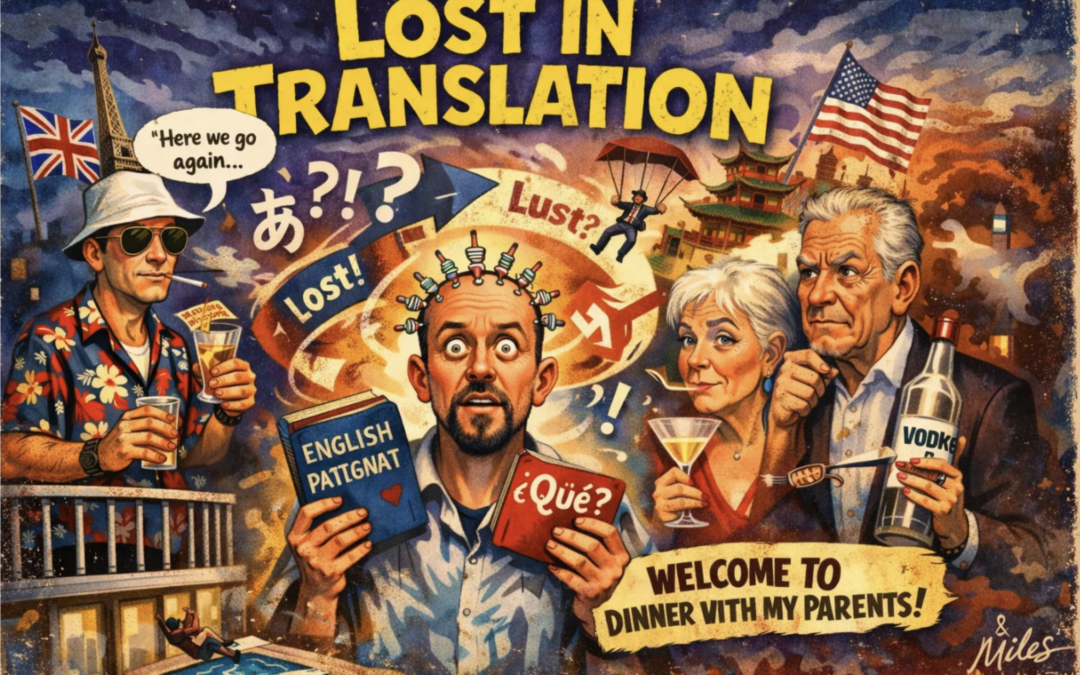
“Here we go again,” said Hunter S Thompson, allegedly, from the top of a very high hotel, doing that thing he did where a sentence starts as commentary and ends as a threat.
“Why did he say that?” interrupts Mother Dearest, scoffing down the last of her Scouser cocktail. Ten percent white wine, ninety percent cheap vodka, one hundred percent dubious upbringing.
She swirls it around her mouth thoughtfully, as if she’s tasting oak, cherry, and palindromic misunderstanding, then turns to my father’s quizzical left eyebrow.
Cedric Father has only heard the second half of the sentence and is now wondering what, exactly, is going on at the top of this hotel, and whether there are rules against it.
“Miles has a friend who jumped out of a hotel room many times,” Mother Dearest explains, filling in the missing parts of my story with details that exist only at her current blood-alcohol level.
Mothers’ happiest moments were always when they were being gently nudged into a small Drinky-poo or two to “take the edge off”. The more it made sense to her in the moment, the less it would ever integrate into the story later. Coherence was optional.
“Why did he jump?” asks Father, eyebrow number two joining the party.
“And what happened the first time he jumped off?” asks Mother, then answers herself: “I suppose he was in a small hotel.”
“Was he now?” wonders Cedric Father. “Maybe he landed in a swimming pool,” he offers, contributing to the embellishment. “But there should be rules against things like that.”
“He was saying ‘Here we go again’,” I try to explain. “It’s an ambiguous statement. It could mean anything. That’s the interesting part.”
Mother’s hand hovers over the box of white wine, then settles on the vodka bottle. “No point watering down the good stuff,” she says, pouring herself a little todger.
“How is your friend?” asks Father.
“Which one?” I ask.
Welcome to dinner with my parents, where simple sentences go to die.
“The one that jumped out the window, stupid boy!” spits Mother, delighted now that she believes she’s tracking the plot.
Nobody has jumped. Nobody has died. My story was never about a hotel.
But off we go.
Welcome to dinner with my parents, where simple sentences go to die.
When One Word Ruins Your Appetite
It’s not always this dramatic. Sometimes it’s far worse.
The previous evening, the evening debate is about to begin. It’s 19:00 on the dot. The wine cold, the food hot, the child expected to be quiet and grateful.
“We can’t stop here,” says Father, prodding one of Mother’s eggy comestibles, about to launch into something provocative to which I will have no choice but to take an opposing position and allow the evening debate to commence.
“One of the main problems is that people don’t masturbate enough.”
He is leading me toward some semantic subterfuge to which I am ill-prepared to respond.
The sentence lands on the table like the halitosis of a dead Tasmanian devil. I have no immediate reply. He got me there, I think. Clearly there has been some preparation for tonights debate.
There is dead silence after a comment like that. A pause so pregnant it should be paying school fees. You know what I mean?…. and I am sure that you do.
“l am sorry?”, I think in my rather tentative and well practised cognitive dissonances trying not to picture my eighty-year-old father… you know… whatever.
He is leading me toward some semantic subterfuge to which I am ill-prepared to respond.
Our father is making a point that I can’t quite get to, I think to myself.
“Don’t end your thinking with a preposition,” says Mother, without looking up.
Did I say that aloud? Or can she read my mind? Is it getting hot in here?
“That’s a comment up with which I shall not put,” I say, quoting Churchill with profound viscosity, hoping the sheer pomp will disinfect the conversation.
Father meticulates on “They don’t spend enough time enjoying it. They just sit down and swallow it down without a thought. Bloody stupid people.”
“OK, he is on a roll tonight” I think. Mother glares once again. What is it with Mothers and their intuitive and precognitive looks?
As one of the mangrove warbler eggs has just lodged itself in between my oesophagus and that wiggly waggle thing in the back of my throat* I begin to choke.
“Speak up boy,” he says. “Do you have something to say?”
Panic slowly, Miles. Remember your lessons.
“Mother,” I begin, “it’s a bit much speaking to me about… you know… Father… and all that.”
“Our child never listens,” Father announces, resuscitating the conversation.
“People don’t masticate their food enough,” he says, finally revealing the missing letter. “They don’t chew. You know what masticate means don’t you, silly child?”
I do.
I mean I do know what it means.
I don’t… you know… whatever.
So many things are lost in translation.
So many things in my life have been lost in translation, often between someone’s mouth and my ADHD brain, which receives a sentence, drops it on the floor, then hands me a completely different sentence and says, Here. React to this instead.
The Death Conversation (And the Zoo Proposal)
Later that same meal we wandered into the realm of dying, as families do when they’ve run out of safer topics like politics, religion and incest.
Father, logical mind that he is, reasoned that at eighty he has little chance of living many years past this point of chronological cacophony.
One can’t debate this with much expectation of success for three reasons:
- He is right.
- He is my father, who is always right. If he is wrong, see point 1.
- There is no point three. Point three has been eradicated by the recursive nature of points one and two.
Mother gets a bit depressed when Father talks about dying. It isn’t helped by his claim that he doesn’t want money wasted on a coffin. He’d rather be fed to some animals at the zoo.
“It’s not like I’m going to notice,” he says. “I’ll be dead and starting to smell a bit.”
This is not comfort. This is logistics.
But in his mind, it’s also kindness. Practicality. No fuss. No theatre. No sentiment.
That’s Cedric Father’s dialect. Very British. Cool as an English cucumber, or radish, or a cool pumpkin. Does it always have to be a cucumber?
The Last Handshake
Some people share many loving and memorable moments with their fathers.
I shared only two.
The first arrived years later, in a casualty department full of stupid people who had done stupid things to themselves, like falling off motorbikes and stabbing themselves in the foot.
Father’s new cancer treatment has triggered off what we thought was a mild heart attack. I had dutifully brought him in on this strangely windless and warm Sunday evening in the heart of the Eastern Cape of South Africa.
“Stupid bloody people,” muttered Father under his breath, even then, even there, loyal to his favourite mantra.
Some people share many loving and memorable moments with their fathers.
He hadn’t had a heart attack. He was simply exhausted from his treatment and “healing”. He spent the night in hospital and I sat next to him until he fell asleep.
I was suddenly hyper-aware that the man who had taught me to argue, debate, stand my ground, sniff out bullshit and resolve the inherent incongruent chaos of the world may be running out of debate time.
The next day I came to fetch him.
Before I left to drive the 300km back to my own life, Father shuffled into the kitchen with his walking stick and held out his hand to shake mine.
A handshake. Not a hug. We were English. We didn’t do hugs. Hugs were for people who had processed feelings. We were officers and we were gentlemen.
He shook my hand like he’d never met me before, stared me in the eyes, and said:
“Thank you for looking after me last night.”
From the outside it looked like nothing.
From the inside it was a cathedral.
I looked back at him and said it was my deepest pleasure and honour to look after my father.
It was the last time we shook hands.
The Sentence That Didn’t Get Lost
A week later Mother called. Father had fallen out of bed. She was in a wheelchair. The neighbour arrived. There were comments about carers and frail care and the quiet terror of a life getting smaller.
When I walked into the bedroom I realised there would no longer be any need for the walking stick.
Father would never walk again.
This was a major risk. We were English. We didn’t say things like that. It felt unfair to drop a sentence like that into the room and expect him to catch it while his body was leaving.
I helped him drink his favourite lemon drink and laid his far too bony cranium gently onto the pillow.
And I thought: it’s now or never.
Say it. Don’t translate it. Don’t soften it. Don’t try to be clever.
“I love you Dad.”
This was a major risk. We were English. We didn’t say things like that. It felt unfair to drop a sentence like that into the room and expect him to catch it while his body was leaving.
He blinked, looked at me, and said:
“I love you, matey.”
Which is pretty much as good as it gets.
Nothing was lost in translation at that moment.
It had taken forty-six years for us to exchange those words, but they landed cleanly, like a coin finally hitting the bottom of a well.
Words are slippery, actions less so.
But sometimes, if you stop trying to win, and you just say the thing, the words behave.
And the rest of your life is basically learning the difference between those two moments.
*Wiggly Waggly Thing AKA Uvula. A small, teardrop-shaped piece of connective tissue and muscle hanging from the soft palate between the tonsils. Apparently. Use it, don’t use it. I just did.
by Miles Harrop | Jun 23, 2026 | Uncategorized
A man is walking his little brown dog on a hot and strangely windless summer afternoon in January of 1987. He looks at a discarded polystyrene pallet with what looks like some dishevelled, withered, and dried-out bean sprouts. He turns to his little dog, whose name must for now remain a mystery, and tut-tuts. He wonders what the world has come to.
What the world had come to for me on that day was somewhat tumultuous and worthy of a tut-tut. That massacre of bean sprouts still gives me the shivers and makes me walk in a special way when the weather is cold and damp.
It seems like a strange place to begin my story of standing up again. But stranger things have happened before, and the bean sprouts are only the beginning.
I had been driving back from my mother’s errand to pick up bean sprouts for my father’s favourite salad. Father did enjoy his scheduled and planned dinner time: 19:00 on the dot.
Bean sprouts should be fresh, the lasagna hot, and the child quiet.
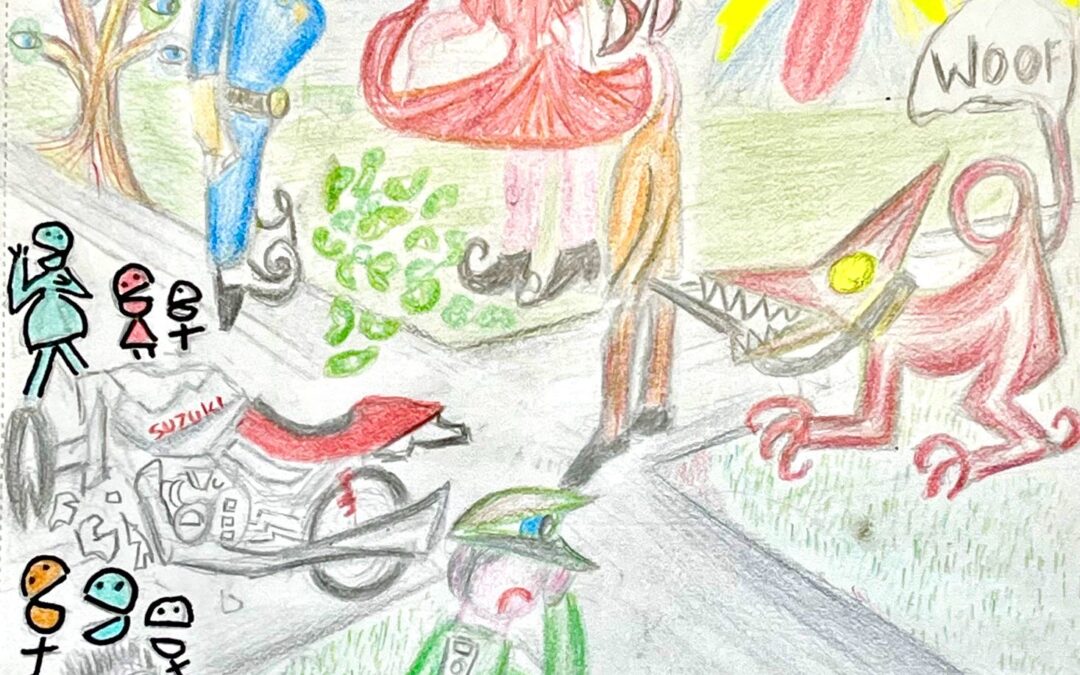
I was on my Suzuki 650 Katana motorbike. “Vroom ba ba” went the 650 cc motorbike engine as I cruised gently down the road.
The bean sprouts that I had just purchased from the shop were flapping around between my shirt and my chest on this exceptionally warm but strangely windless January afternoon in the beautiful Eastern Cape of Southern Africa.
It is strange and lovely to experience an afternoon in the Eastern Cape where there is not a breath of wind. It makes the residents a bit crazy. Today feels like a lazy crazy day. People are driving in a slow, lazy way.
As I was approaching a road to the left, I could see a beach buggy in front of me, indicating to turn right. I began to overtake in a lazy way on the left, as people do from time to time.
The driver was not turning right, and herein began the difficulties in our short-lived yet impactful relationship. He was turning left, and he was turning left before I got past him.
It is an immutable fact of science that two objects in the same physical dimension can’t simultaneously occupy the same physical space.
We entered into a form of dispute over that little space in the universe.
I lost.
It could have been a very nasty knock, but I was lucky he only tapped the side of my engine, and I bruised my knee on the side of his car.
I would have been OK if it were not for my mother’s hairdresser’s husband, Al, and his Toyota Corolla, who now both, bizarrely, enter the story.
Al also happened to be shooting off to the shop to buy some bean sprouts to go with his own lasagna that night.
Al presented me and my motorbike with a bit of a conundrum. He was now in the way of my errant beach buggy-influenced trajectory.
There is a silence that occurs mentally during that split second of an accident. My life didn’t flash before my eyes. I just forgot everything. It’s a blissful silence.
And then you wake up.
My first memories were of seeing the bean sprouts. What those poor things had been through. I have to pick those up, I thought distantly.
Even more distantly, I was trying to figure out why I was no longer on my motorbike — something about my mother’s latest hairdo…
I tried to get up.
I didn’t.
To say that the pain was excruciating would be an understatement overshadowed only by that of the Black Knight in Monty Python’s Quest for the Holy Grail.
“It’s just a scratch.”
“It’s just a scratch, Miles.”
“Get up.”
“Can’t.”
“Hurts.”
“Need help.”
The standing-up thing was perhaps ill-considered and did not match the external environment.
Oh look, a distraction. There is Johann, my best friend. He looks worried, and he is not coming any closer. Peering at me from a distance.
He has seen a commotion on the way to come and see me at my house. We were going to the beach.
The news is now spreading through my little hometown: Cedric Harrop’s son has been knocked down; he is hurt.
He is hurt badly.
Am I hurt? I think. Just can’t get up.
“It’s just a scratch.”
“Get up.”
“Can’t.”
“Hurts.”
Some truth bombs begin to land a little too close for comfort. I have a problem here. I can hardly breathe or move.
“It’s time to get up,” my mother would tell me when I lay in too late.
“I mean it, really, it is time to get up.”
“Can’t.”
“Hurts.”
“Need help.”
Today is the 27th of January 1987. Just one week into my new school year, one which I had mentally prepared for.
I had to stay focused. I have a goal. I have to pass my matric. It was not going to be an easy task. I had not actually passed my previous year. As an undiagnosed ADHD child, I was regarded as disruptive and a slow learner.
My schooling was poor. My friendship groups were, at best, interesting; at worst, morally dubious.
I had one thing going for me, though. I had started doing really well in the amateur bodybuilding scene. The skinny little boy from the UK, the one who used to get bullied, the one that looked like a little twig insect, had become well-known and respected in the bodybuilding and physique competitor world.
I didn’t play the normal sports that boys should play. I was a problem, my father would tell me. He was very disappointed in me a lot of the time.
“You’ve got this, Miles. Get up.”
“Can’t.”
“Hurts.”
“Need help.”
The muscles in my back, which had for two years consecutively won me a bodybuilding title, had turned into knots of molten hot lava.
More people are arriving, stopping on the side of the road. More mutterings.
I notice that my brand-new top is torn; it’s only the second time that I have worn it. It is white with large multi-coloured lips painted on it in psychedelic colours. There is some blood seeping into it. Hmm, I think, I wonder where that is coming from?
I am feeling very vulnerable right now; I can see feet and legs. It hurts to even try to look up.
“It’s just a scratch, you sissy.”
“Get up.”
“Can’t.”
“Hurts.”
“Need help.”
I hear a fast-moving car suddenly slam on brakes, spewing up the gravel verge. The panicked opening and slamming of a car door, the definitive and authoritative stomping of definitive authoritarian feet.
The separation of the crowd like the Red Sea and the unashamed entrance of a dramatic and imposing figure. Father has arrived.
The military uniform with the requisite set of pilot’s wings, the single surname badge “Harrop”. My father’s stint in the Air Force meant a uniform that commanded respect, most fitting for Father.
The rubbernecked observers are peering and looking and chatting and comparing notes.
“So glad it’s not me.”
“Bloody motorcyclists are windgat.”
“Hello John, long time no see, how are the kids?”
“It’s not my fault; he turned into me. Stupid motorcyclist.”
And now a different voice, a different tone that demands to be listened to: “Which bloody stupid little twit is responsible for this?”
For once in my life, I know the answer to this question. I’ve had to answer that one many times.
I can feel my right arm wanting to rise and take full responsibility. My right arm won’t move.
“Bloody stupid people”, father sneers.
Thankfully, he has not noticed that my top is torn; I would hate to be reprimanded in front of all of these people, especially in my vulnerable fetal position.
He has a short fuse, does Father. In fact, that doesn’t do it justice. Father has no fuse whatsoever. He could move from analytical scientific observation to a volcanic earth-destabilising explosive venom-filled supernova in milliseconds. You don’t want to be on the wrong side of Father’s tongue when he is displeased.
Father has not said anything about the bean sprouts, which I have spilt on this barren ground. They should be in the fridge, I think distantly to myself. I try to clear them out of the way of Father’s polished shoes.
My arm is still being disobedient; it’s not doing what I tell it to do. The other arm seems to be at a strange angle. I don’t remember being able to do that yesterday, I thought.
Father slowly bends down to bring his face closer to mine. I know what he’s thinking. Miles did not shave today.
If there’s something worse than having a motorbike accident on a hot summer’s day and making a spectacle of myself, it would be doing all of this in an unshaven state. The sheer embarrassment.
But Father is not looking at me; he’s looking at my motorbike, which until recently had been lying on top of me. He “tut-tuts” in disappointment.
I try to speak. I can't. Not only does it hurt, but I have also now developed a stutter for the first time in my life; I seem to be lacking compression every time I try to speak.
Cedric’s eyes widen; his pupils constrict; he’s not happy, and he is not getting bean sprouts tonight. He stands back up again with ease, something I won’t be doing for quite a while.
Like a Cape vulture, he surveys his territory, looking for his prey, and like a Spanish inquisitor, correctly hones in on the one person who seems to be oddly out of the group.
He nails it.
The man in the overalls was, in fact, the driver of that beach buggy. He blinks. Father sees him blink.
The driver of the beach buggy has embarrassed Cedric and inconvenienced him.
Cedric booms in a sneering, teasing, derogatory, and condescending way, emphasising each word, perfectly enunciated in his cultured London accent.
“Which stupid little man knocked my son over?”. He ties the question into a double bind. Whoever puts their hand up to admit that they knocked me over is simultaneously admitting that they are, in fact, a stupid little man.
The tribe of bloody stupid people were not having any of it. There were no immediate volunteers to answer the particular question. But as we all know, a blink is as good as a nudge to a blind man in the dark.
All eyes sadly shifted to poor blinking Mr Blue overalls, whose name was Phillip. None of us knew that at the time, except perhaps his parents, but they weren’t there, so like the name of the dog at the beginning of the story, Phillip’s name remained a mystery.
Mr Blue overalls shifted nervously, looking desperately at the ground for some form of defence or inspiration. Neither arrived, but Cedric did, right up to his nose.
“You are a stupid little man! What are you?” asks Cedric rhetorically.
My mind drifts once again. It wanders to Japonica and a poem by Henry Reed on the “Naming of Parts”. On this hot summer’s day, yesterday was what to do after training; tomorrow will be what to do after motorbike accidents, but today, today will be the naming of parts, and in my case, the naming of broken parts. I don't know which bits are broken. It's a tad awkward.
My poetic meanderings have been interrupted for a second as I hear a nervous “Hello; Major Harrop…Cedric?” It breaks Father’s concentration and the death gaze.
It’s Eric, the policeman!
If you’ve grown up in a smallish town, you know the dynamics. You know the postman’s name, the butcher, the baker and the police. We didn't use candles in those days, so I didn't know the candlestick maker's name. You were about to ask; I can tell.
I stare at this gathering tribe of people now being shuffled around by Constable Eric. The tribe had entered into relationships of somewhat redundant intimacy, staring at this boy on the ground with his bean sprouts withering like his breath in front of him on a hot and strangely windless summer’s day.
Nowadays, I describe myself as an executive performance coach, and I take pride in asking well-thought-out and good questions.
Eric was not an executive performance coach. He was not proud of asking good questions.
“How are you?” asked Eric, demonstrating his apparent inadequate question-asking abilities.
You have to be kidding, I thought; what the actual flip? Do you mean existentially how am I? Well, that’s a question mark, so if it’s OK with you, let’s move on to the next question. How am I in a general wellness way? Well, perhaps you could take into account some of the evidence in front of you.
I did not say any of that.
I could not talk, remember? I said that earlier. Go and look.
What I did actually do was sort of grunt through my clenched teeth as if I were trying to squeeze something very big out of something very small. I was squeezing due to the chest injury (currently not diagnosed). I was indeed struggling to breathe, and breath, you may agree with me, is the Genesis of many a good word and speech.
“Let me help you get up,” said Eric.
“Can’t. Hurts,” I squeaked.
Eric abandoned his attempt at pulling me and dropped me back on the ground. Thump went Miles, with a suspicious grinding sound in my back.
“Oopsy doopsy,” he said cheerfully. But not before tugging on my arm and seemingly bending my shoulder into an even more uncomfortable and unseemly position, and relief.
He then puffed up his substantial chest for the audience of rubbernecks. For the first time, he seemed to realise that there was, in fact, an audience, and Eric did love so much to play to the audience.
There he was with his shiny gun and shiny shoes and policeman’s hat; the police had now arrived, and everything would be OK.
Well, not everything; there was the matter of Cedric’s bean sprout salad.
The police were fun; they were friendly; they were accessible. Not particularly efficient at being policemen, but you can’t have everything, can you?
“Bloody stupid people,” sneered Father to no one in particular.
“Indeed,” replied the hairdresser’s husband, Al.
“Look at that,” said Cedric, gesticulating to either the broken motorbike or the withering bean sprouts. “What a waste.”
“Pam sent the odd one to the shop to get my supper,” he said.
“I don’t like bean sprouts,” said Mr Blue overalls, stupidly, I thought, but who am I to judge?
Mr Blue overalls continued, “They remind me of imperialistic hot cuisine scoffed by privileged bourgeois elitist slave drivers, and as such, I distance myself from them.” Mr Blue overalls did exactly that and stepped away.
But before anybody could continue to deepen the conversation on salad dressing, there was the Pee-paw of an incoming ambulance.
Although the Pee-paw poor was, in all honesty, not totally necessary, as most cars capable of movement in the areas were pulled up on the side of the road to watch the show.
Eric’s chest had puffed up to monumental proportions as he paraded himself in front of a new lady audience member.
She has a very short skirt, I thought to myself from my particular view. I can nearly see her…
“Where does it hurt? How are you? What happened?” asks one of the paramedics.
“Bloody stupid people,” I hear Father uttering under his breath once again. For once, I must concur.
“Which question do you want me to answer first?” I try to say. Of course, by now, if you’ve been following, you know that I asked something sounding like “Ugg?”
“Would you like to get up?” asks the paramedic, continuing his litany of stupid questions and solidifying and cementing for eternity my view of stupid people.
Can’t stand, can’t breathe, can’t talk.
A blessed and welcoming dark coat of unconsciousness flows over me after the effort of trying to answer those questions. After what feels like a few seconds, my eyes open again; more people have arrived for the afternoon’s festivities.
Father is not in control. I am not in control. We are both certainly not in control right now.
All of that’s of minor importance and not worthy of consideration, thought Cedric to himself; I have three problems to solve.
Number one: get the unshaven odd one off the grass and out of sight. He is unseemly and certainly unparliamentary, not good for the Harrop name.
Secondly, how am I going to fix that bike?
And lastly, perhaps most importantly, worthy of extreme consideration, what is for dinner tonight? It’s getting late.”
How did I know what my father was thinking?
Good question, because I’m also wondering the same thing. I was indeed beginning to hear voices.
Could it be that, as you were looking over there at the lady with the short skirt and the bean sprouts withering away on a strangely windless summer’s day, that there has been certain attentions applied to my general state of unwellness through a gas mask and syringe?
I had been field-dressed, injected, dripped, splinted and prepared for the journey to the hospital. I was shovelled unceremoniously onto a cold stretcher and once thereupon was slid into an awaiting ambulance.
Pee-Paw ambled the ambulance up the near-empty road, leaving behind a temporary tribe of rubbernecks staring at a haphazard scattering of bean sprouts screaming their last into the universe on this strangely windless hot summer’s day.
I had been put on my side because they could not stretch me into a lying flat position that would have been more appropriate. The medic used his foot to try and straighten me out a bit, but it hadn’t worked, so they left me in that snail-like fetal position.
The painkillers continued their work. I continued the journey, striking up deep, meaningful conversations with family members both dead and alive; there was also a large talking rabbit at one stage with a large pocket watch and a man with a large hat. I didn’t catch their names, though.
Once I had been ceremoniously delivered to the casualty unit, I was handed over to Nurse Andrews in her starched and tight-fitting nurse’s uniform. On another day, I might be so inclined as to cast a young man’s scavenging and critical eye over the topography of her nurse’s uniform; today, I didn’t.
“How are we today?”
Are you related to Policeman Eric? I thought.
“Can’t move. Arm won’t work. Can’t speak.”
I pulled up my shirt to show her my stomach muscles, which had stopped working on half of my body.
I said to her, “Look, stopped working.”
We both looked at my stomach muscles not working; quite interesting, very interesting; it was. One side did not flex at all; its asymmetry added to the general lopsided appearance of my body.
My head was still sort of facing towards my crotch as if I were looking for something interesting there. The something in my crotch area had retracted somewhat, although it still seemed to be there, fortunately.
“Never seen that before,” said Nurse Andrews, not so reassuringly.
“It’s a penis,” I said. I can’t just see it right now, I said.
“I mean your stomach muscles, silly,” she said, pulling back her shoulders and pushing out her ample chest in my direction. She is related to Eric, I thought. She winked. Some of her parts wobbled whilst she administered another stronger something-something into the drip.
I thought back to my departure from the tribe on the side of the road. My lasting memory as I departed was seeing Johann’s forlorn and worried face. He did worry a lot.
I think he was the only person who remembered why the temporary tribe had gathered and found themselves in that semi-permeable and accidental tribe state on the side of the road with a tray of bean sprouts starting to bake in that strangely windless summer afternoon in East London.
This temporary tribe that had gathered for one accidental purpose, never to be put together again, to share with me from both biased and unbiased perspectives the changing of my life.
A truly unique day for me; my first rebirth had been witnessed by as many as 40 people, all of them victims, observers, and perpetrators in their own right.
All gathered for this one event, which heralded in such a substantial change in my life. All witnesses are oblivious to the impact of this trauma and how it would affect their own future interactions.
Did they all look a little more carefully when driving home?
Did they look out for motorbikes?
Did they exaggerate the injuries that they witnessed?
The sight of the man flying over his handlebars.
The smash of the bike rider with the white T-shirt as he hit the Toyota waiting at the intersection.
The sound of the thump of a 250-kilogram bike landing on a boy with a tray of bean sprouts.
Were you there that day? Who can say what you might have witnessed out of the corner of your eyes as you drove to the shop on that hot summer’s day devoid of breath?
When you went to bed that night, and your mind drew back to what you saw, you may have decided to proffer advice on certain matters.
How to drive.
How to be defensive.
How to pay attention.
How to avoid things falling on you.
How to get up when you’ve fallen and can’t get up again.
How to recover from an oopsy doopsy and where to store fresh produce when driving home on a motorbike.
You may similarly proffer tips on how to fall.
And how to stand up.
I am really interested in how to get up after a hard fall. It might not always be possible straight after a fall. If you are badly injured, you may need some time, and you may need some help.
“There, there”, advised Nurse Andrews, slipping a needle out of the drip. And as I lie back to enjoy my imbibed enhanced injection of oblivion with a lurking pain in the distance, I begin to dream.
I dream of a man who is walking his little brown dog along a road on a strangely windless and warm summer evening. He perchances across signs of a commotion on the grassy verge. His little brown dog, ill-disciplined as he was, begins to sniff at the grass where there is some broken glass, oil, and perhaps a little blood.
The man with the little brown dog tut-tuts as he turns his gaze away from the massacred and now sun-dried bean sprouts in the Eastern Cape of South Africa on this, strangely windless, hot summer’s day, and wonders what the world has come to, and whether his lasagne will be ready by the time he gets home.